Addition and Subtraction of Time: Your No-BS Guide to Time Math
Learn about time calculations, productivity tips, and how to make the most of your time with our comprehensive guides.
Published on December 19, 2025
Addition and Subtraction of Time: Your No-BS Guide to Time Math
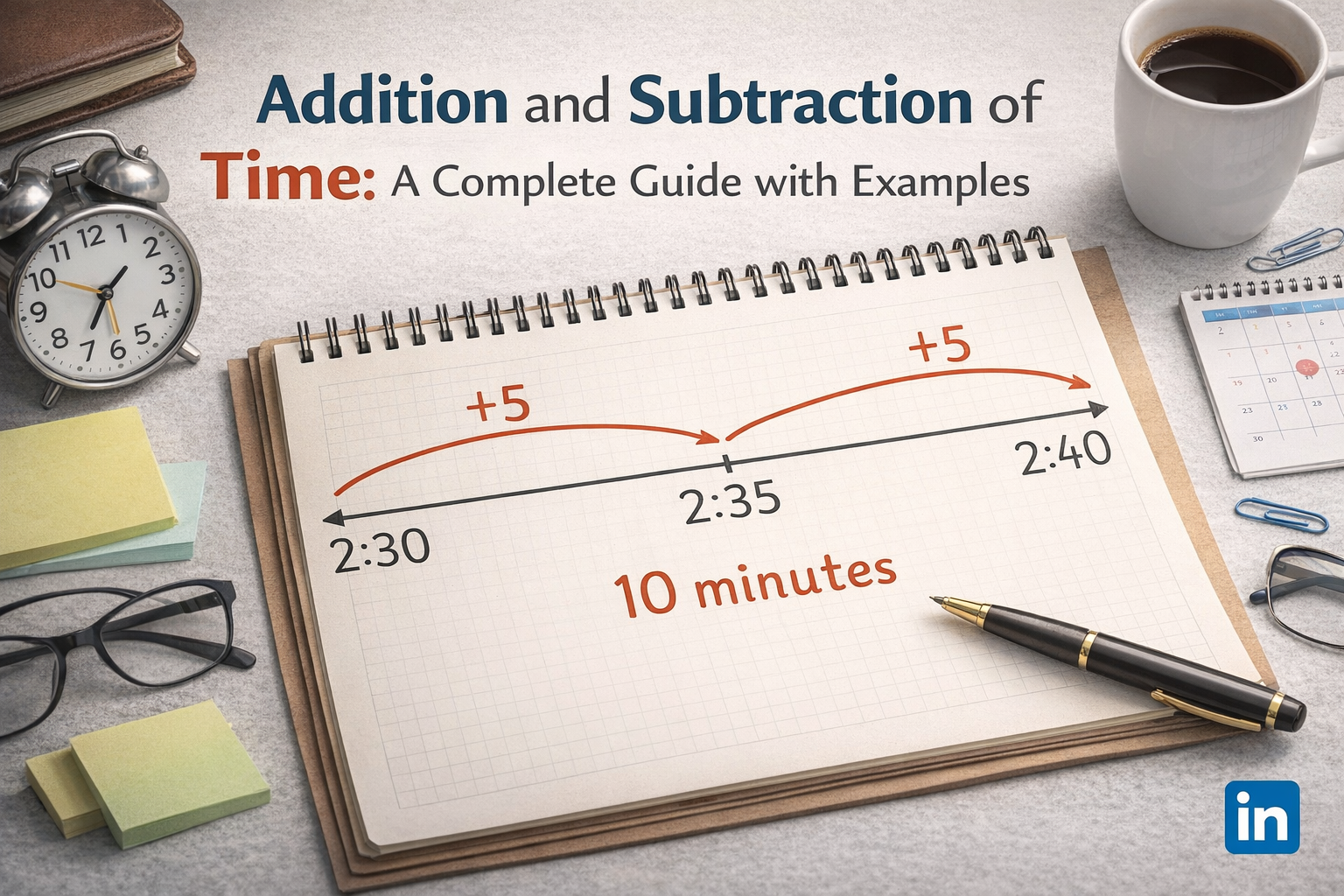
Alright, let's talk about time calculations. Not the boring textbook stuff - the real-world, actually-useful kind that helps you figure out when things start and end.
Look, we've all been in that situation where we're trying to calculate how long something takes, or what time we'll finish if we start now. Maybe you're wondering "if I start this project at 2 PM and it takes 3 hours and 45 minutes, when am I done?" Or "I've got 8 hours till my deadline - is that enough time?"
Let me break this down so it actually makes sense.
The Foundation Stuff (But Make It Quick)
Before we get into the fun calculations, here's what you absolutely need to know:
- 1 hour = 60 minutes (not 100, even though that would be way easier)
- 1 minute = 60 seconds
- 1 day = 24 hours
That's your toolkit right there. Everything else builds on this.
Adding Time: When You Need to Know "When Will This End?"
Adding time is basically figuring out time duration from your starting point. The trick? Handle hours and minutes separately, then combine them.
Here's the deal:
- Add your hours together
- Add your minutes together
- If minutes hit 60+, convert to hours (every 60 minutes = 1 hour)
Real Example: You start studying at 3:30 PM. You study for 2 hours and 45 minutes. When do you finish?
- Hours: 3 + 2 = 5
- Minutes: 30 + 45 = 75 minutes
- Convert: 75 minutes = 1 hour and 15 minutes
- Add that extra hour: 5 + 1 = 6 hours, plus 15 minutes
- Answer: 6:15 PM
See? Not scary at all.
Subtracting Time: Finding Out "How Long Did That Take?"
This is where you calculate the time difference between two points. Super handy for tracking how long you actually spent on something.
The method:
- Subtract hours first
- Then subtract minutes
- If you can't subtract the minutes (like trying to take 40 from 20), borrow an hour first
Example: You started homework at 4:15 PM and finished at 6:50 PM. How long did it take?
- Hours: 6 - 4 = 2 hours
- Minutes: 50 - 15 = 35 minutes
- Answer: 2 hours and 35 minutes
When Things Get Tricky (But Still Manageable)
The Borrowing Situation
Sometimes you gotta borrow an hour to make the math work. It's like borrowing in regular subtraction, just with time.
Example: What's the difference between 5:20 PM and 3:45 PM?
- Hours: 5 - 3 = 2 hours
- Minutes: 20 - 45... wait, that's negative!
- Borrow 1 hour (= 60 minutes): 20 + 60 = 80 minutes
- Now subtract: 80 - 45 = 35 minutes
- But you borrowed an hour, so: 2 - 1 = 1 hour
- Answer: 1 hour and 35 minutes
Converting for Different Needs
Sometimes you need your answer in different formats. Maybe your boss wants hours as decimals for payroll, or you need total minutes for a timer.
Quick conversions:
- 2 hours 30 minutes = 2.5 hours (for payroll)
- 1 hour 45 minutes = 105 minutes (for timers)
- 3 hours 15 minutes = 3.25 hours (for billing)
Practice Problems (Actually Try These)
Problem 1: Your gaming session starts at 7:45 PM. You play for 3 hours and 40 minutes. What time do you stop?
Solution:
- 7 + 3 = 10 hours
- 45 + 40 = 85 minutes (= 1 hour 25 minutes)
- 10 + 1 = 11 hours, plus 25 minutes
- Answer: 11:25 PM (late night gaming!)
Problem 2: You worked from 9:20 AM to 5:15 PM with a 1-hour lunch break. How many hours did you actually work?
Solution:
- Total time: 5:15 PM - 9:20 AM
- Hours: 17 - 9 = 8 hours (using 24-hour format)
- Minutes: 15 - 20... borrow! 75 - 20 = 55 minutes
- Actual hours: 7 hours 55 minutes
- Minus lunch: 7:55 - 1:00 = 6 hours 55 minutes
Problem 3: A movie is 2 hours 28 minutes long. If it starts at 3:15 PM, when does it end?
Solution:
- 3 + 2 = 5 hours
- 15 + 28 = 43 minutes
- Answer: 5:43 PM
Common Mistakes (Don't Make These)
Not converting when minutes exceed 60: If you get 75 minutes, don't leave it like that. Convert it to 1 hour 15 minutes. Always.
Forgetting AM/PM: 3:00 AM and 3:00 PM are 12 hours apart. Double-check which one you mean.
Ignoring breaks: If you're calculating work time, subtract your lunch break! Your boss definitely will.
Midnight confusion: After 11:59 PM comes 12:00 AM (midnight), then 12:01 AM. After 11:59 AM comes 12:00 PM (noon). Yeah, it's weird.
Quick Tips to Get Faster
Use the 24-hour format for math: It's way easier. 14:30 instead of 2:30 PM removes the AM/PM confusion entirely.
Break down big numbers: Don't try to add 6 hours and 47 minutes all at once. Add the hours, then the minutes, then combine.
Check your work: Subtract your answer from the end time. You should get back to your start time. If not, you messed up somewhere.
Practice with real life: Calculate how long your commute takes, how much time until your next class, when your show ends. Real scenarios stick better than made-up problems.
The Bottom Line
Time calculations aren't rocket science, but they do require paying attention to details. The key is breaking everything down into manageable steps:
- Deal with hours separately from minutes
- Convert when you hit 60 minutes
- Borrow when you need to subtract smaller from bigger
- Always double-check AM/PM
Whether you're tracking work hours, planning your day, or just trying to figure out when you can finally chill, these skills are genuinely useful. The more you practice, the faster you'll get, until eventually you're doing this stuff without even thinking about it.
Now stop reading and go practice with some real-world examples. Set a timer, track an activity, calculate when something ends. That's how you actually learn this stuff - by using it, not just reading about it.
You may also find this article helpful on Wedding day.
Quick FAQ Because You're Definitely Wondering:
Q: What if I'm working across midnight? A: Add 24 to the PM times or just count it as two separate time periods. 10 PM to 2 AM = 10 PM to midnight (2 hours) + midnight to 2 AM (2 hours) = 4 hours total.
Q: Why do I need to learn this when calculators exist? A: Because your brain is faster than pulling out your phone, and because understanding HOW it works means you catch calculator errors when they happen.
Q: Can I just round everything? A: For personal stuff? Sure. For work or school? Nope. Accuracy matters when money or grades are involved.